
Brand Protection in Indonesia: Addressing the Threat of Counterfeit Products and Reputational Damage
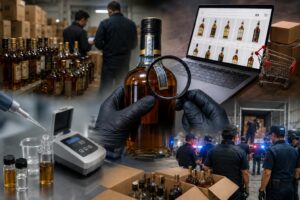
In a warehouse on the outskirts of the city, hundreds of branded bottles were neatly lined up. At first glance, nothing seemed suspicious. However, after a closer inspection by Integrity Indonesia’s investigators, the signs became visible: slightly different seals, labels that looked too flawless, and bottle content that are nothing like the genuine product.
This is not an isolated incident. This is the reality of counterfeit alcoholic beverages in Indonesia today.
In light of the phenomenon, as part of Integrity Indonesia’s 25th anniversary celebration, we interviewed one of our investigation analysts who holds the Certified Fraud Examiner (CFE) credential. After years of handling counterfeiting cases, she has witnessed firsthand how the circulation of counterfeit products has become a serious threat to brand owners, consumers, and market trust.
The Scale of the Problem Cannot Be Ignored
Although there are no official statistics that comprehensively record the total circulation of counterfeit alcoholic beverages in Indonesia, enforcement data from the Police and Customs authorities compiled from various media reports paints a concerning picture:
- Banyuasin (2026): The South Sumatra Regional Police raided a home-based operation in Banyuasin that had produced more than 20,000 bottles of counterfeit branded alcoholic beverages.
- South Kalimantan (2025): Authorities seized 1,399 bottles of counterfeit branded adulterated alcohol.
- Bogor (2021): Police confiscated hundreds of counterfeit imported liquor bottles of various brands, along with materials and equipment used to manufacture fake alcoholic beverages.
“A combination of factors has fueled the widespread proliferation of counterfeit alcohol, including strong market demand. In fact, underage individuals have already been found consuming alcoholic beverages,” our analyst explained.
She also noted that well-known branded and premium imported alcoholic beverages are frequently targeted because they already enjoy strong consumer trust and command high retail prices. These substantial profit margins make alcohol counterfeiting an attractive illicit business.
Modus Operandi: More Sophisticated Than Many Realize
Many people assume that counterfeit alcohol simply involves refilling used bottles with cheap liquids. In reality, the operation is far more organized.
Based on Integrity Indonesia’s investigative experience, counterfeiters often have established networks that supply used authentic bottles. These bottles are collected from bars, restaurants, and nightclubs, then cleaned, refilled with adulterated liquids, and resealed using specialized equipment.
“If counterfeiters are sufficiently sophisticated, they also use equipment that enables them to replicate alcohol seals almost identically to the originals, complete with excise labels that appear authentic,” she explained.
Fieldfindings typically confirm this modus operandi. In addition to counterfeit products, investigators often discover used authentic bottles, bottle-sealing machines, and production materials that frequently fail to meet food-grade standards.
Perhaps the most concerning aspect of this scheme is its distribution aspect having expanded into digital channels. Counterfeit alcoholic beverages are now openly sold on online marketplaces, taking advantage of limited seller verification procedures. Offline, nightclubs have become major distribution points, where both genuine and counterfeit products are sometimes sold simultaneously to maximize profits.
How Anti-Counterfeiting Investigations Work
Effective enforcement and brand protection efforts always begin with a structured process that generally includes the following steps:
1. Market Monitoring
Integrity’s investigation team first examines online channels to identify stores offering imported products at suspiciously low prices. The clearest initial red flag is a selling price that falls significantly below market standards.
2. Test Purchase
Once preliminary indicators are identified, the team conducts a test purchase. Investigators equipped with in-depth product knowledge will identify anomalies such as:
- Bottle seals and weight
- Liquid color
- Aroma that does not match the authentic product profile
When necessary, Integrity also possesses specialized equipment capable of comparing the characteristics of the purchased liquid with those of the authentic product. This analysis helps strengthen indications of counterfeiting before the investigation proceeds to the next stage.
3. Field Investigation and Legal Enforcement
Using shipping information, the team traces the physical location of the producer. This process requires considerable expertise in building trust within high-risk environments.
Once the production site has been confirmed, Integrity collaborates with authorities, including Customs and the Police, to carry out raids. All findings are subsequently documented in a comprehensive investigation report for the brand owner.
The Impact on Brand Owners: More Than Financial Losses
When counterfeit products circulate in the market, the consequences extend far beyond loss in sales. Brand reputation becomes the primary stake.
“When we conduct a raid and it receives media coverage, they often do not mention ‘counterfeit alcoholic beverages.’ Instead, they directly mention the brand name that was counterfeited. Media narratives are beyond our control,” the analyst explained.
This means that every news report about counterfeit alcohol raids indirectly associates the affected brand with the word “fake” in consumers’ minds, even though the brand itself is the victim. In more severe cases, counterfeit products made with non-food-grade materials can cause serious health consequences for consumers, potentially triggering a far deeper reputational crisis.
Counterfeiting threats can emerge from unexpected sources and brand protection cannot be purely reactive.
Three Strategic Brand Protection Recommendations
Based on years of field experience, our analyst outlined three critical measures every brand owner should consider:
- Conduct consistent online and offline market monitoring. Market monitoring is not a one-time activity but an ongoing process. Online marketplaces must be monitored regularly, as they have become primary entry points for counterfeit products.
- Educate consumers about authorized distribution channels. Consumers who know where to purchase genuine products represent the most effective first line of defense against counterfeiting.
- Build a collaborative brand protection ecosystem. Effective protection requires cooperation among brand owners, professional investigation partners, authorities, and digital platforms to limit the operational space available to counterfeiters.
Brand Protection Is Essential for Every Industry
The counterfeit alcohol cases described above illustrate how reputations built over many years can be undermined by counterfeit networks. However, there is one important lesson that business leaders should recognize: this threat is by no means limited to the alcoholic beverage industry.
Sophisticated tactics—from utilizing authentic packaging and manipulating seals to exploiting online marketplace vulnerabilities—have become universal methods replicated by counterfeiters in other industries. Even though your company operates in healthcare, cosmetics, automotive parts, apparel, or technology products, the risk of losing customer trust remains the same.
Ultimately, brand protection is not merely an additional cost for certain industries. It is a fundamental investment for any business seeking to safeguard product quality, maintain consumer loyalty, and ensure long-term sustainability in the marketplace.
25 Years of Protecting Brands: A Commitment That Continues to Evolve
Throughout Integrity Indonesia’s 25-year journey, counterfeit alcohol cases have continually reminded us why this work matters. Every counterfeit bottle circulating in the market not only causes financial losses for brand owners, but also has the potential to endanger consumers and erode trust in brands that have been built over many years.
Integrity Indonesia’s brand protection services encompass market monitoring, anti-counterfeiting investigations, and support for enforcement operations, all designed to serve as both the first and last line of defense for your brand in the marketplace. We also actively foster collaboration with authorities through training programs and discussion forums to strengthen the handling of counterfeit products in Indonesia. Because ultimately, a strong brand is a protected brand.